


Why Choose Consons?
- Comply With RoHS/REACH Standards, Supporting Exports To The EU
- 100% AOI Inspection and Flying Probe/Fixture Continuity Testing for Every PCB
- Supports Blind/Buried Vias, Heavy Copper, Multilayer Hybrid Lamination, etc.
- Flexible MOQ, With Prototypes Starting From 5 Pieces
- Free DFM Review, With A Manufacturability Risk List Provided Within 24 Hours
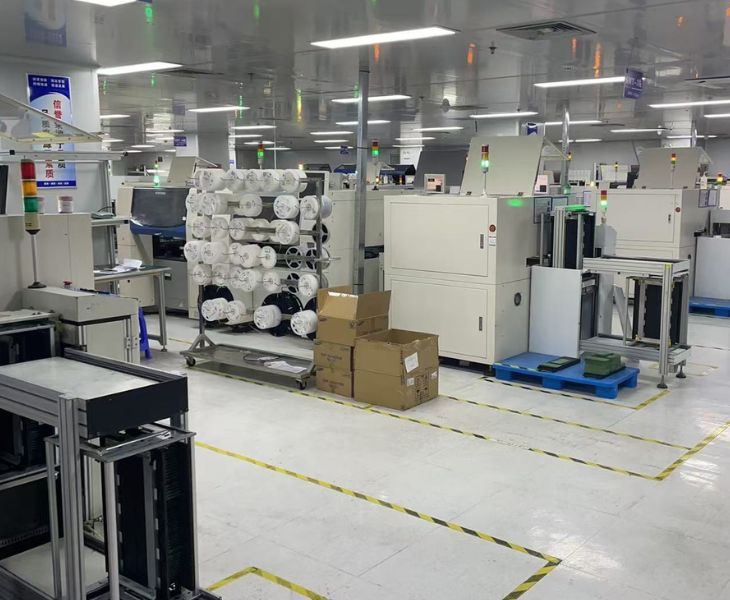
Turnkey Battery PCB & PCBA Solutions Provider
Consons is an experienced EMS service provider. We provide turnkey battery PCB and BMS protection board solutions, covering PCB fabrication, component sourcing, and SMT/DIP assembly.
We specialize in high-series-count cell monitoring boards, high-current power boards, and low-leakage protection boards for battery packs. They can be used in electric vehicles, energy storage systems, power tools, and consumer electronics.
For battery applications, we focus on sampling consistency, insulation safety, and long-term reliability, to reduce the risk of inaccurate battery readings, electrical leakage, and high-temperature failures.
In terms of quality control, we use AOI, flying probe testing, and insulation and withstand voltage tests throughout production. UL 94 V-0 flame-retardant materials are used as standard. Also, we support RoHS, REACH, and automotive certifications that will simplify your import and export process.
Types of Our Battery PCBs
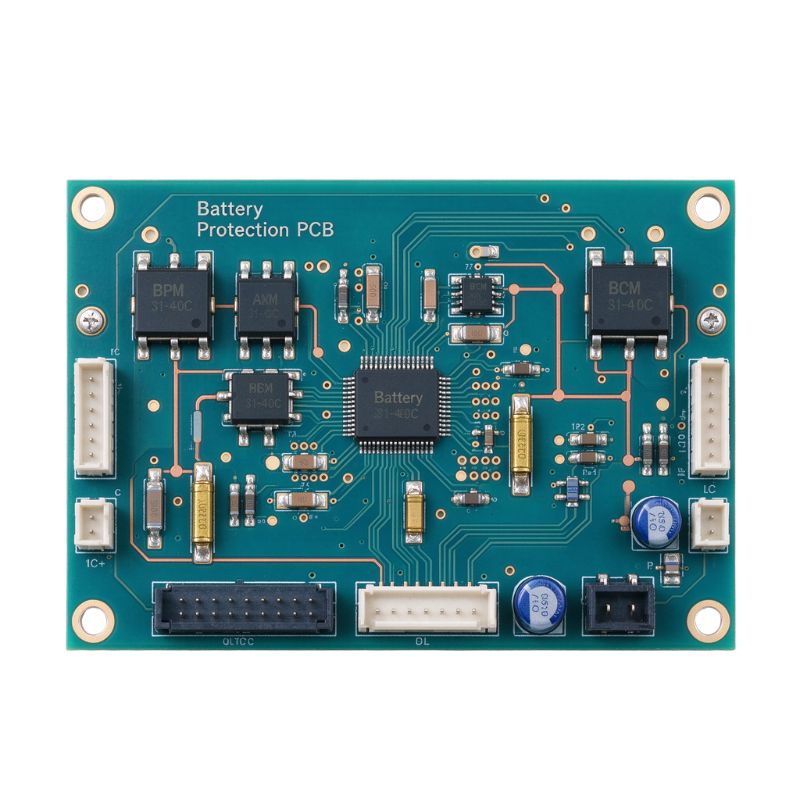
It consists of protection ICs, MOSFETs, current-sense resistors, fuses, and can protect the cells from overcharge, over-discharge, overcurrent, short circuits, etc.
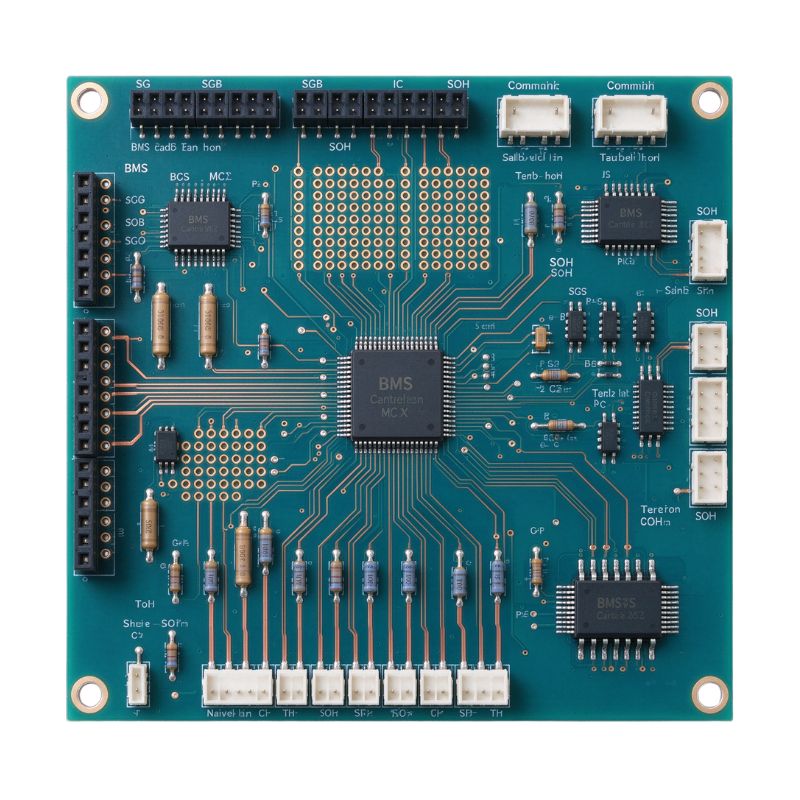
It monitors the battery pack, calculates SOC and SOH, balances the cells, communicates with external controllers, and controls the main power circuit.
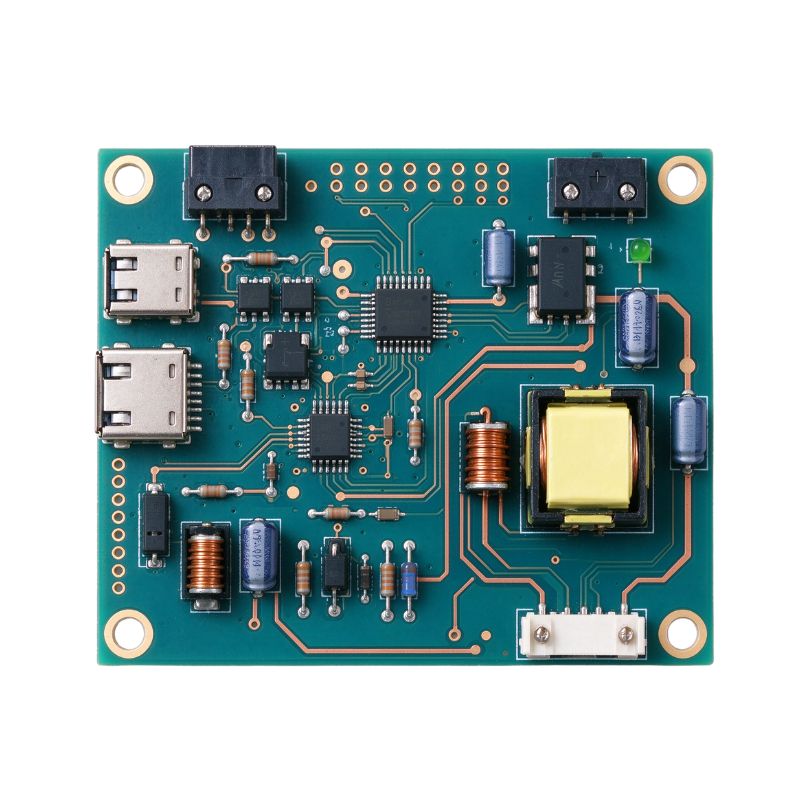
External power sources, such as USB ports and solar panels, will be converted to the proper voltage and current for battery charging.
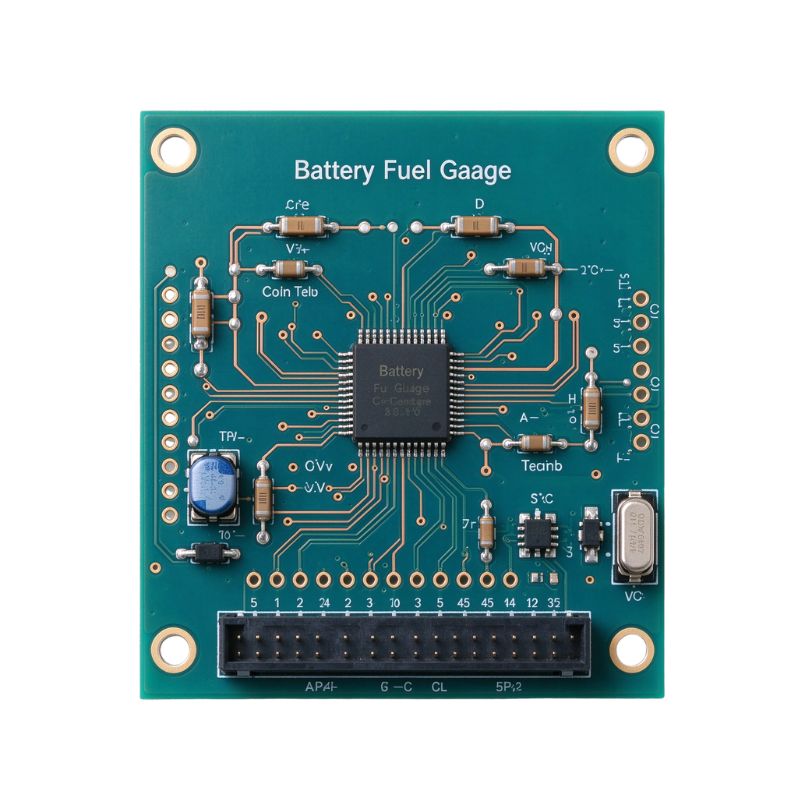
It monitors the battery’s remaining charge, voltage, current, and temperature in real time, and sends the data to the host system or user through communication interfaces.

It is used to connect cells in series or parallel, carry high currents, and transfer power. The PCB also has very low resistance and excellent heat dissipation.

It is usually installed inside the battery module or pack and handles different functions: protection, monitoring, balancing, communication, and connections.
Features of Consons’ Battery PCBs

We use high-CTI, UL 94 V-0 flame-retardant materials. Through this, the risk of fire and electrical leakage when the battery overheats will be reduced, thus improving the overall safety.

We support placement accuracy of up to 0.025 mm, 01005 components, and BGA/QFP packages with a 0.3 mm pitch, which supports us in building compact, high-density boards.

The PCB has full and uniform solder joints, which can greatly reduce the risk of power interruptions and increased contact resistance in vibrating environments.

We optimize the pads and stencil openings through DFM, to reduce the voids and improve the PCB’s heat dissipation, current-carrying capability.
Custom Process Capabilities
Consons supports the production of battery protection boards for smartphones and main BMS control boards for energy storage systems.
We support multilayer, HDI, heavy-copper, rigid-flex, aluminum-based, and metal-core PCBs. We can also design custom-shaped PCBs, stepped slots, castellated holes, and gold fingers to fit the battery pack design. This reduces wiring and adapters, simplifies the system design, and shortens assembly time.
In addition, you can specify the post-assembly processes, such as selective conformal coating, EMI shielding covers, and heat sink attachment, as part of our integrated service.


Suitable For Harsh Operating Conditions
If you need to use the battery PCBs in outdoor energy storage systems, electric two-wheelers, and automotive battery packs, we offer high-Tg materials, solder mask, and conformal coating. This helps the boards maintain reliable insulation over the long term, even under high-temperature, high-humidity, and salt-spray conditions.
For automotive- and industrial-grade products, we will carry out design reviews for thermal cycling and vibration reliability; this can reduce the risk of solder joint cracking under vibration, temperature shocks, and also extend battery pack service life.
Specification
| Item | Options |
| Layer Count | 1–12+ Layers (HDI Any-Layer & Rigid-Flex available) |
| Base Material | High-Tg FR-4 (Tg170/180), low water absorption, high insulation resistance |
| Copper Thickness | 1–6 oz (Up to 12 oz upon engineering review) |
| Min. Trace/Space | 3/3 mil |
| Min. Hole Size | Mechanical 0.20mm Laser 0.10mm |
| Hole Copper Thickness | Avg. ≥20μm Min. ≥18μm (IPC Class 2/3) |
| Impedance Control | ±10%, differential 100Ω / single-ended 50Ω |
| Insulation Resistance | ≥10⁹Ω @ 85℃/85%RH (damp heat) |
| Hi-pot Test | 500V DC / 1min (customizable per battery pack voltage) |
| Operating Temperature | -40℃ ~ +125℃ (1000 thermal cycles) |
| Flammability | UL94V-0 |
| Warpage | ≤0.75% (≤0.5% for thin boards) |
| Surface Finish | ENIG (default), hard gold, OSP, immersion tin |
Applications of Battery PCBs

Battery PCBs can be used in BMS master/slave boards, 48V mild-hybrid/start-stop battery control boards, and OBC/DC-DC power boards. They support multi-cell voltage monitoring, cell balancing, and overcurrent protection. The PCB can also handle high-current power conversion and better thermal management.

You can use them in battery protection boards for power tools, battery management boards for garden tools, and battery protection boards for electric bicycles and scooters. When manufacturing, we use heavy copper and protection against vibration, moisture, and heat to reduce false protection under heavy loads and ensure stable outdoor operation.

Battery PCBs can be used in battery protection boards for smartphones and tablets, battery management boards for laptops and tablets, and battery boards for TWS earbuds and smartwatches. Consons supports ultra-thin HDI, multilayer low-power, rigid-flex PCB designs, and ensures safe fast-charging.

Consons battery PCBs have high-reliability protection, accurate battery fuel gauging, high-rate discharge capability, and safety redundancy. They can be used in battery management boards for portable patient monitors and ventilators, battery packs for electric surgical tools and mobile medical carts, and battery boards for wearable medical monitoring devices.
Battery PCB Customization Workflow
From engineering assessment to after-sales service, Consons offers a complete one-stop workflow for battery PCB customization. Each step is strictly controlled to deliver reliable battery circuit boards matching your specifications.
After receiving your Gerber files, BOM, and engineering requirements, we will confirm the completeness of your files within 4 hours and provide a formal quotation within 24 hours. At the same time, our NPI engineers conduct DFM/DFT reviews for your battery PCB and check key risk points
We manufacture PCBs according to your requirements, with support for heavy copper, HDI, rigid-flex, and other processes. Next, based on the confirmed engineering files, we source components through multiple channels and perform 100% IQC inspection on all incoming materials.
If any components are out of stock, we can suggest compatible alternatives based on your BOM.
We support secure IC programming and post-programming verification. Moreover, our factory only performs the programming process and does not access or read the core logic. After SMT assembly, we perform AOI and X-ray inspection in sequence. At the same time, the MES system records data throughout the full process.
Consons has 7 assembly lines, which are able to carry out battery pack, battery module, and complete box-build assembly. We also support conformal coating, adhesive dispensing, and other post-assembly processes, to ensure proper fit and consistent assembly.
We perform ICT/FCT based on your project requirements. It covers all the key battery PCB functions, such as overcharge, over-discharge, overcurrent, short-circuit, temperature sensing, cell balancing, and communication interfaces. If needed, we can also add aging tests, environmental stress tests, charge/discharge cycle tests, and other tests.
If you don’t need special package methods, we use ESD and moisture-proof packaging for PCBs. The commercial invoices, packing lists, COCs, test reports, RoHS/REACH declarations, and other customs clearance documents will also be shipped with the products.
Yes. We support small-batch validation from EVT/DVT/PVT through mass production. For standard battery PCB processes, the prototype MOQ starts from 5–10 pieces, while the small-batch production starts from 50 pieces. We also support mixed-order production.
The MOQ for standard 2–6 layer battery PCB prototypes is 5–10 pieces, and its lead time is 5–7 working days. Prototypes with high layer counts, heavy copper, special surface finishes, or rigid-flex construction typically need 8–12 working days.
We can recommend the appropriate copper thickness based on your current-carrying and temperature-rise requirements. We support copper thicknesses from 6 to 12 oz. The exact thickness should be confirmed after an engineering review.
Yes. We support impedance control for CAN, RS485, and other communication lines on Battery PCBs. We can also design the layer stackup and perform impedance testing based on your requirements or industry standards, such as 100 Ω differential impedance.
Yes. We support custom multi-series BMS cell monitoring boards, including 20S, 32S, and higher series counts. We will optimize the PCB layout, cell balancing circuits, and isolation design based on the number of cells and the required sampling accuracy.
Yes. We will give you test reports for insulation resistance, ionic contamination, and dielectric withstand (Hi-Pot) testing, which meet the reliability and safety verification requirements of battery protection boards for automotive, medical, and energy storage applications.
Yes. We protect your intellectual property across the entire process. We sign an NDA and IP ownership agreement with you to clearly define ownership of the design files, firmware, and test programs. All design files will be stored in encrypted systems with access controls, and are only accessible to authorized engineers.
We provide at least a 12-month warranty. During the warranty period, if you have any concerns about product quality, we will confirm the affected batch within 24 hours of receiving your feedback, and start an 8D analysis within 3 working days, with preliminary findings and containment measures provided.
Get Your Customized Battery PCB Solution
Send us your Gerber files, BOM, and requirements for a fast quote and engineering review.