

The selection of PCB materials directly affects the signal integrity, reliability, thermal management effectiveness, and service life of the PCB. This article will give you a detailed introduction to the characteristics and types of PCB materials, helping you choose the most suitable PCB material for your product.
What Is PCB Material
The full name of PCB is Printed Circuit Board. Therefore, PCB materials refer to various materials used for manufacturing printed circuit boards.
From the structure of a PCB, the material is a laminated board, which plays a role in carrying copper lines, transmitting electrical signals, and soldering components. The selection of different laminates has the greatest impact on PCB products.
Types Of PCB Materials

FR-4
FR-4 is one of the most common PCB substrates, accounting for 80% of the market share in the electronics industry. It is usually composed of fiberglass cloth and epoxy resin. Fiberglass provides FR-4 with good rigidity and stability. Therefore, it can meet the needs of most rigid PCBs. In addition, the insulation properties of FR-4 are excellent. It can provide good insulation even in humid environments. The supply chain is mature, and processing technology is popular. So it is easier to control processing costs.
But you need to take notice that its high-temperature performance is average and not suitable for high-temperature heat dissipation scenarios. In high-temperature environments, its high-frequency signals suffer from poor heat dissipation.
CEM-1 / CEM-3
The full name of CEM is Composite Epoxy Material. It is a composite PCB material. Among them, CEM-1 is a paper-based composite material, while CEM-3 is a fiberglass composite material. The performance of CEM-3 is usually better than CEM-1.
Compared to FR-4 material, CEM material has a lower cost. But its mechanical strength, heat resistance, and complex PCB processing capability are usually not as good as FR-4. Its main advantages are simple processing and low cost.
When your product does not have high performance requirements, and you want to control costs, then CEM materials are a good choice for you. But if your product is automotive, industrial control, high-reliability equipment, etc., then it’s best not to choose it.
High-Tg Materials
It is a material that improves the glass transition temperature by optimizing the resin system and material formulation based on traditional FR-4 materials. It is a modified variant built on a traditional FR‑4 resin system, as it has a higher thermal performance level and is more suitable for high-temperature environments.
We know that FR-4 material has average high-temperature performance and is not suitable for high-temperature heat dissipation scenarios. However, when PCB materials work in high-temperature environments for a long time, it requires better thermal stability, or when it is subject to high-temperature soldering/reflow processes.
If your PCB material requires good thermal performance but you don’t want to spend a lot of budget on high-frequency or ceramic materials, then you can choose high-Tg materials.
Rogers / High-Frequency Materials
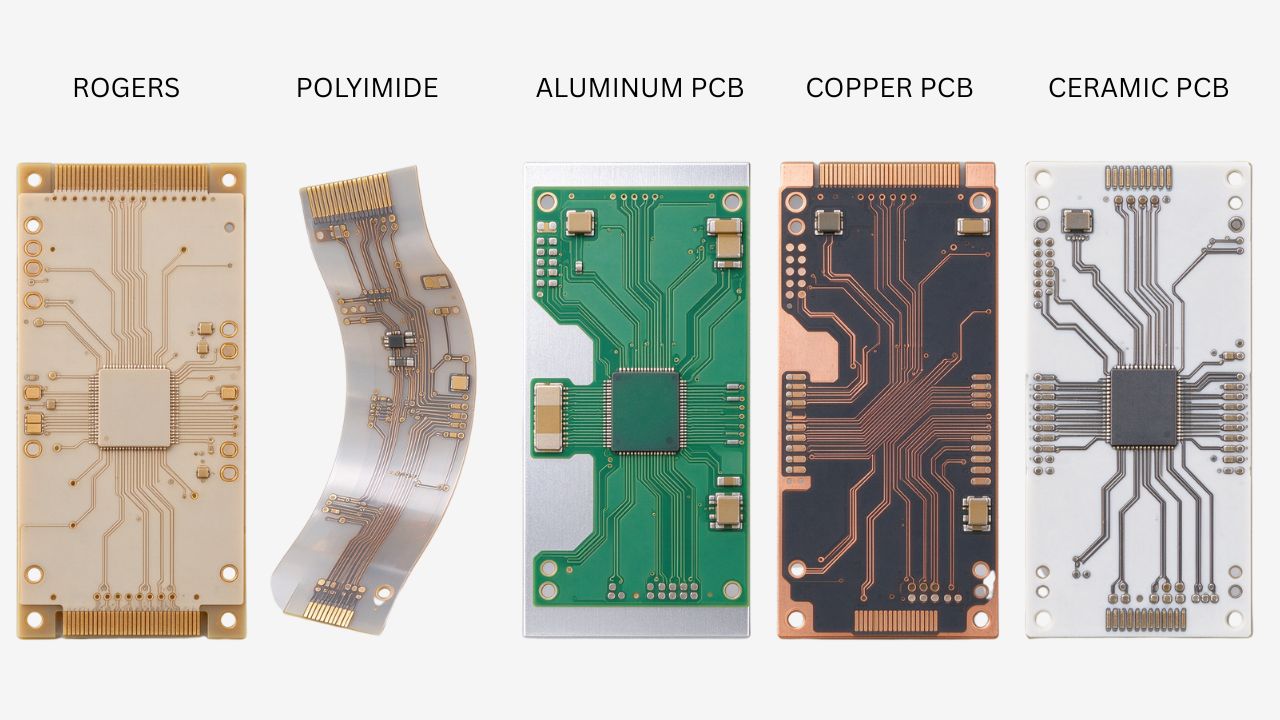
Rogers/high frequency materials are specifically designed for manufacturing high-frequency/microwave PCBs.
This material is usually composed of ceramic-filled PTFE, thermosetting resin/fiberglass, and other materials. It has good performance, stable dielectric properties at different frequencies, and excellent performance in high-frequency signal transmission.
But its cost is high, and some materials also have high manufacturing requirements. If your product involves fields such as 5G communication modules, RF boards, millimeter wave devices, high-speed digital circuits, satellite communication equipment, etc., then you can choose Rogers/high frequency materials.
Polyimide
Polyimide is a very important material in flexible PCBs. Its biggest advantages are flexibility and heat resistance. It can bend to a certain extent and can even be used in dynamic bending structures.
Its cost is slightly higher. But if your device is designed with flexible circuits, then it is very suitable for your product. It is used in many different fields, such as, wearable devices, foldable electronic products, and precision medical equipment.
Aluminum PCB
Aluminum PCB is also known as a metal core PCB. Its biggest feature is the use of metal substrates to help the PCB dissipate heat. Aluminum-based structures can conduct and diffuse the heat generated during PCB operation from heating elements to larger areas, thereby achieving heat dissipation.
In addition, aluminum PCB also has advantages in weight and cost. It is more suitable for large-scale, cost-sensitive heat dissipation applications. If your PCB mainly aims to solve the problem of heat dissipation efficiency, then give it a try.
Copper-Based PCB
Compared with aluminum substrates, copper substrates have better thermal and electrical conductivity. Therefore, they are more suitable for scenarios with high requirements for thermal conductivity and high current-carrying capacity.
But it has the problem of heavy board weight and relatively high processing costs. It has a high cost and is only suitable for high-end, high-power scenarios.
Ceramic PCB
Ceramic PCB uses ceramics as the substrate. It has excellent insulation, thermal conductivity, and high-frequency and high-temperature performance, as well as a low coefficient of thermal expansion and stable chemical properties.
The biggest drawback of ceramic PCBs is their high price. It is usually used as a high-end industrial specialty material and widely applied in high-frequency communication, aerospace, precision medicine, and high-power semiconductors.
| Type | Advantage | Limitation | Cost | Typical Applications |
| FR‑4 | Strong universality, mature processing, high cost-effectiveness | Poor high-frequency and heat dissipation performance | Low | Ordinary consumer electronics |
| CEM‑1/3 | Extremely low price and light weight | Poor stability, does not support multiple layers | Extremely low | Simple single panel |
| High‑Tg FR‑4 | Heat resistance, warpage resistance, and thermal shock resistance | Poor high-frequency performance | Low | Industrial control, automotive electronics |
| Rogers | Low DK/Df, stable RF performance | High cost and difficult processing | High | 5G, RF, and high-speed circuits |
| Polyimide(PI) | Flexible and heat-resistant | Price higher than rigid board | Middle | Wearable and flexible devices |
| Aluminum PCB | Excellent heat dissipation performance | Unable to make complex multiple layers | Middle | LED, high-power supply |
| Copper‑Based PCB | Extremely strong heat dissipation capability | Heavy emphasis and high price | Extremely high | Ultra-high-power industrial module |
| Ceramic PCB | Good insulation, high-frequency and high-temperature stability | High brittleness and cost | Extremely high | Aerospace, precision medicine |
How To Choose PCB?
When you choose PCB materials, you cannot blindly pursue high-end materials. You should consider many different aspects comprehensively and then choose the material that is most suitable for you.
Consider the Properties of Materials
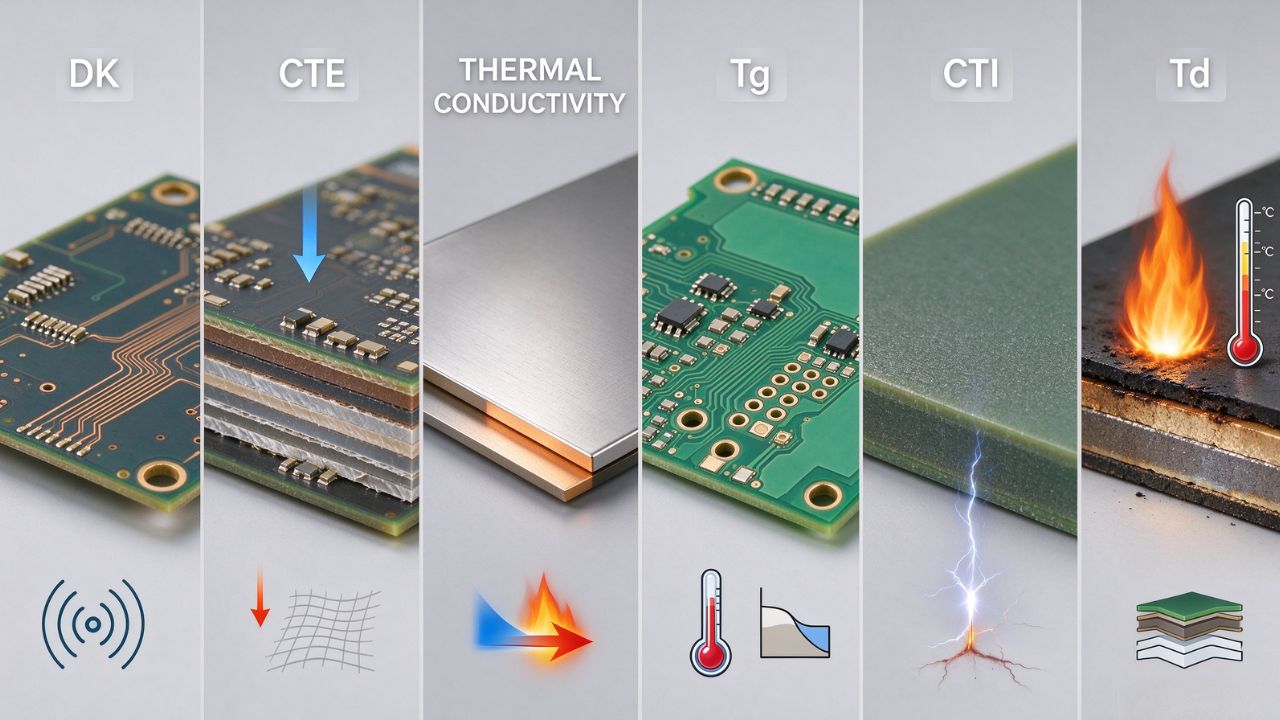
When choosing materials, you had better consider their electrical and thermal properties, including DK, CTE, thermal conductivity, Tg, and so on.
- DK: DK represents the ability to store electrical energy. It directly affects the impedance stability of the material. In the case of ordinary circuits, the impact is small. However, in the case of high-frequency digital and RF circuits, fluctuations in Dk may cause signal delay and impedance offset issues.
- CTE: CTE represents the degree of material change when temperature changes, usually divided into two dimensions: the XY plane and Z-axis thickness.
If CTE is large, the material may experience problems such as metalized hole fracture, hole ring fracture, and layer delamination. Therefore, when you design a PCB, you had better choose low-CTE materials.
- Thermal conductivity: Thermal conductivity is the thermal conductivity efficiency of a material. The thermal conductivity of different materials varies. Those materials with low thermal conductivity have poor heat dissipation. It may lead to heat accumulation when used in high-power devices.
Devices with high heat rates will dissipate heat from the board quickly. If your product is a high-power or LED device, then you should select materials with good thermal conductivity.
- Tg: Tg is the critical temperature at which the substrate resin material changes from solid to soft. It is the core indicator for evaluating the high-temperature resistance of materials during the welding process.
- CTI: CTI is a safety indicator for measuring the resistance of materials to surface leakage and marking in high-pressure and humid environments. The higher the value of CTI, the stronger the insulation and leakage resistance of the material.
- Td: Td is the temperature at which the resin undergoes thermal decomposition failure. You need to distinguish it from Tg. Tg is the softening temperature of the resin, while Td is the complete failure temperature of the material.
Under a lead-free high-temperature soldering process, a high-Td board can avoid resin decomposition, board body foaming, and delamination, ensuring the quality of the PCB.
The selection of materials is very important for the efficiency of a PCB. Before you choose the materials, it is best to understand the characteristics of these materials.
Confirm Product Requirements
When you design a product, you need to have a sufficient understanding of your product. The requirements of this product directly determine the type of material you choose. For example, low-speed and affordable products can choose FR-4 and CEM series materials to control costs. High-end, high-power products can choose copper-based PCBs.
Determine Budget
The budget has a significant impact on the selection of materials. You don’t necessarily have to choose high-end materials. On the premise of meeting performance and certification requirements, you can choose those materials within the budget range.
If your product involves high-end fields such as medical, automotive, aviation, etc., then I suggest you ensure the performance of materials and increase your budget appropriately.
Choose A Reliable Supplier
Finding suppliers is also important. A reliable supplier can not only provide you with high-quality materials, but also give you advice based on your needs to help you reduce unnecessary losses. You should choose a supplier with mature technology, customization, and a complete after-sales system.
FAQ
Can Polyimide Work In High-Temperature Environments For A Long Time?
Polyimide has excellent high-temperature resistance and can operate in high-temperature environments. Ordinary Polyimide can work at temperatures between 120-150 ℃ for a long time, and some modified Polyimide can even reach 180-200 ℃. However, being able to operate in high-temperature environments does not mean it can stay in high-temperature environments for a long time.
If the equipment operates in a high-temperature environment for a long time, Polyimide may face many issues, such as reduced insulation performance and substrate brittleness, which may shorten the equipment’s lifespan.
When you design a product, you have to correspond to the specifications of the material. You should also confirm the temperature at which it can continue to work to avoid the above problems.
Can Aluminum PCB Be Used To Make Multilayer Boards?
In most cases, it is not possible. Due to the limitations of the insulation medium and the lamination process, most aluminum substrates can only be made into single-layer or double-layer structures.
If you want to design multi-layer PCBs, you can choose FR-4 material with high thermal conductivity. If you have special requirements, you can also contact us, and our professional engineers can recommend materials for you based on your needs.
Can Different PCB Materials Be Mixed In The Same Multi-Layer Board?
Yes. However, it should be noted that the properties of different materials are different, and mixed use may result in problems such as poor interlayer bonding, high internal stress, and plate warping.
If your project requires mixing multiple materials, you had better consult professional designers in advance. Consons has rich experience in customized processing and a team of designers. If you have customization needs, you can contact us to obtain customized design solutions. Our engineers will evaluate your needs to design the best solution for you.
What Are Common Challenges Encountered In PCB Material Processing?
During the process of PCB material processing, there are often issues such as drilling and mechanical processing, thermal stress and dimensional changes, material processing compatibility, delamination and glass, and material consistency.
Therefore, in the process of PCB material processing, you should choose the right PCB material and adjust the drilling, lamination, heat treatment, and welding processes according to the characteristics of the material.
Consons provides one-stop processing services. If you want to reduce the burden of PCB processing, we can help you do it.
Can FR-4 Board Be Used On RF Circuits?
Yes, but not all FR-4 materials can be used for RF circuits.
FR-4 material can be used in some RF applications with low frequency or low requirements for high-frequency loss. However, the dielectric constant and dielectric loss control of FR-4 are usually not as stable as specialized high-frequency materials, which may lead to a series of problems such as increased difficulty in impedance control and signal loss.
Therefore, for applications such as high-frequency, millimeter-wave, radar, etc. that require low signal loss and high dielectric performance, Rogers and other specialized high-frequency PCB materials can be chosen.
What Is The Difference Between Polyimide And FR-4?
The biggest difference is the flexibility. FR-4 is mostly used in regular rigid PCBs, while Polyimide is mostly used in flexible PCBs. Polyimide usually has a higher cost, and FR-4 tends to have a lower price.
FR-4 is mostly used in ordinary rigid PCBs and multi-layer PCBs, while Polyimide is mostly used in FPCs, flexible circuits, and high-temperature electronic devices. If you are unsure which material to choose, you can consult us, and we will recommend materials that suit you.
Final
There are various types of PCB materials; there is no suitable material selection plan for all situations. Consons has extensive experience in PCB. If you have other questions when you design a PCB, please feel free to contact us at any time.